


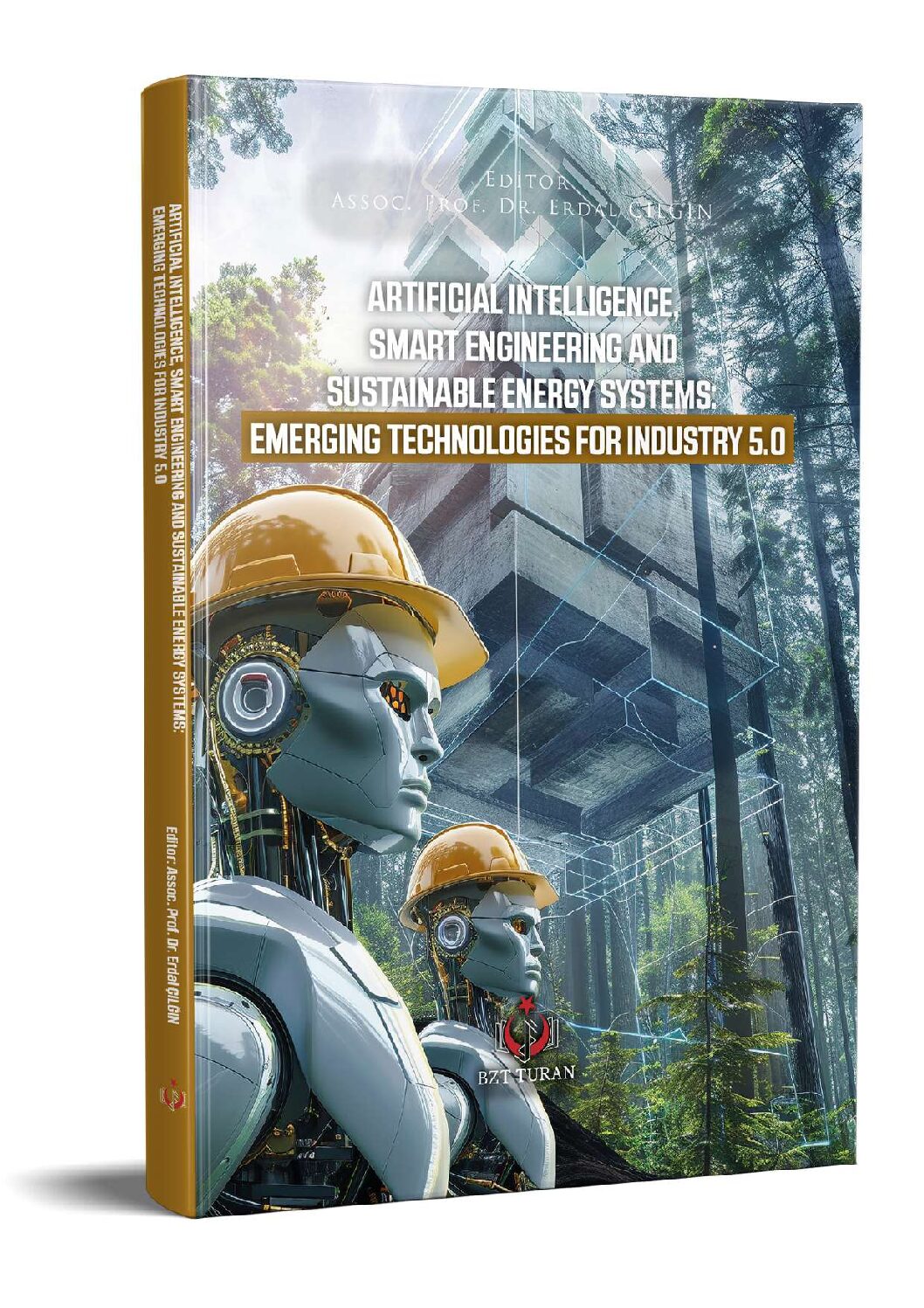
Description
PREFACE
The twenty-first century is witnessing remarkable advances in artificial intelligence, digital transformation, sustainable energy technologies, advanced materials, and intelligent engineering systems. These technological developments are fundamentally transforming the ways societies generate and utilize energy, design smart materials, optimize industrial processes, improve healthcare services, and develop innovative engineering solutions. At the same time, global challenges such as climate change, increasing energy demand, environmental sustainability, resource scarcity, and rapid digitalization require interdisciplinary scientific research capable of integrating theory, experimentation, and technological innovation.
This edited volume, Artificial Intelligence, Smart Engineering and Sustainable Energy Systems: Emerging Technologies for Industry 5.0, brings together original contributions that address contemporary challenges in engineering, energy technologies, materials science, computational modeling, and intelligent systems. Although each chapter focuses on a distinct research topic, they are united by a common objective: developing innovative scientific and engineering solutions that promote sustainability, efficiency, reliability, and technological advancement within the framework of Industry 5.0.
The volume begins with studies focusing on advanced materials and sustainable engineering technologies. These chapters examine innovative approaches for developing functional materials with applications in energy storage, photoluminescent technologies, environmental sustainability, and advanced engineering systems. Novel nanocomposite supercapacitor electrodes synthesized from recycled waste materials demonstrate environmentally friendly alternatives for high-performance energy storage, while investigations on photoluminescent phosphor materials highlight their potential applications in forensic imaging and optical technologies. Complementary research on coal mining waste-derived materials further illustrates how advanced structural characterization techniques can transform industrial waste into valuable functional materials, supporting circular economy principles and sustainable environmental management.
Energy systems and engineering optimization constitute another major theme of this volume. A comprehensive thermodynamic investigation of recuperative Organic Rankine Cycle systems explores efficient waste heat recovery technologies capable of improving energy conversion efficiency while minimizing environmental impact. In addition, computational analyses of insensitive energetic materials provide valuable insights into the influence of binder selection on detonation performance, demonstrating how thermochemical modeling can support the design of safer and more efficient engineering materials.
The book also emphasizes the growing role of computational mathematics and numerical modeling in solving complex engineering problems. Two complementary chapters investigate inverse discontinuous Sturm–Liouville problems involving delay terms through advanced spectral theory, inverse nodal reconstruction, and numerical approximation techniques. These contributions demonstrate how mathematical modeling and computational analysis continue to provide powerful tools for understanding complex physical systems and developing reliable numerical methodologies applicable across multiple engineering disciplines.
Taken together, the chapters presented in this volume demonstrate the convergence of advanced materials, sustainable energy technologies, computational mathematics, numerical simulation, environmental engineering, and intelligent scientific research. Rather than representing isolated scientific investigations, these contributions collectively illustrate how interdisciplinary collaboration can generate innovative solutions to contemporary technological challenges while supporting sustainable development and the transition toward Industry 5.0.
We hope that this volume will serve as a valuable resource for researchers, engineers, scientists, graduate students, and professionals working in materials science, energy engineering, applied mathematics, computational science, and related disciplines. It is our sincere expectation that the knowledge presented herein will stimulate further interdisciplinary research, encourage scientific collaboration, and contribute to the development of innovative technologies for a more sustainable, efficient, and technologically advanced future.
Finally, we express our sincere gratitude to all contributing authors for their valuable scientific contributions, dedication, and commitment to advancing knowledge in their respective fields. Their expertise and scholarly efforts have made this volume possible and significantly enriched its interdisciplinary perspective.
Editor
Assoc. Prof. Dr. Erdal ÇILĞIN


Reviews
There are no reviews yet.