


Description
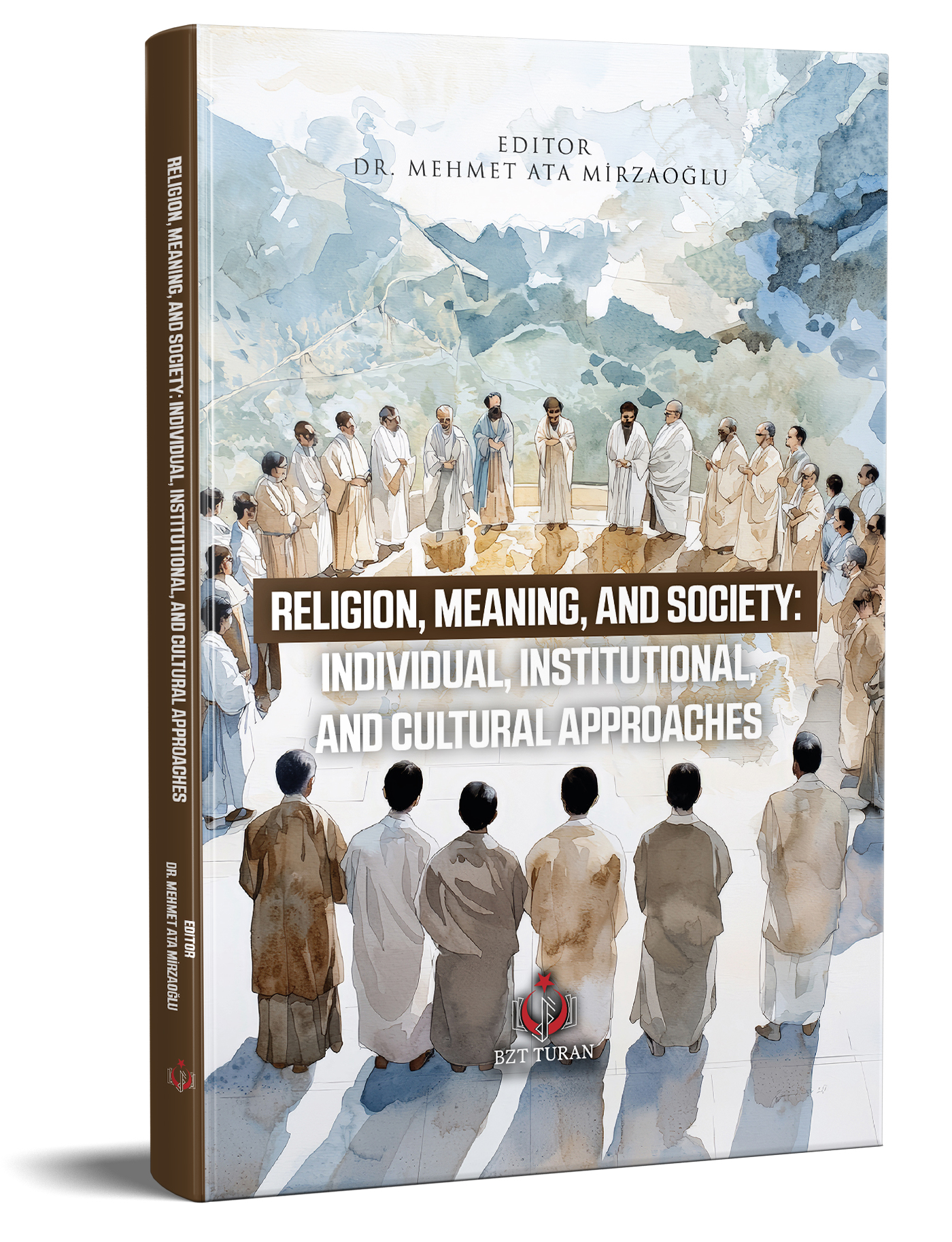
This book is grounded in the premise that religion is not merely an individual phenomenon confined to the sphere of personal belief, but a multilayered structure that generates meaning, shapes behavior, forms institutions, and profoundly influences social relations. Religious experience extends beyond the individual’s inner world to encompass social institutions, cultural texts, and economic structures, thus operating across a wide spectrum of social life. Accordingly, the present volume aims to examine this multidimensional influence of religion from a sociological perspective and across diverse contexts.
The book consists of five chapters which, although they may appear distinct at first glance, converge on a shared conceptual foundation. Each chapter reveals religion’s capacity to produce meaning and demonstrates how this meaning is constructed and negotiated at both individual and collective levels in different social fields. The primary objective of the volume is to analyze the effects of religion—from individual psychology to social structures, from cultural expressions to institutional processes—within a holistic and integrative framework.
The first chapter provides a sociological analysis of the relationship between religion and society through the metaphor of oxygen and carbon dioxide. While religion can function as a form of “spiritual oxygen” that sustains social life, it may also become a source of social tension and polarization when interpreted excessively or detached from its contextual foundations. This chapter establishes a theoretical framework for understanding the dynamic relationship between religious meaning-making and social balance, a theme that runs throughout the book.
The second chapter examines Yâr-i Yâdigâr, a Mawlid al-Sharif authored by İhramcızade İsmail Hakkı Toprak, within the conceptual frameworks of ummah consciousness and intercession. The analysis highlights the role of religious-literary texts in constructing collective identity, belonging, and social consciousness. In this context, religion is approached not only as a system of belief, but also as a repository of meaning that preserves and transmits cultural memory.
The third chapter focuses on the institutional and economic dimensions of religion by analyzing the relationship between customer service quality and customer satisfaction in Islamic banking, with a case study from Tanzania. This chapter demonstrates how religious principles are translated into contemporary economic practices and how they contribute to the formation of trust-based social relations within modern financial systems.
The fourth chapter explores the relationship between religious education and psychological well-being, emphasizing the transformative role of religious knowledge in shaping individuals’ mental health, self-perception, and overall outlook on life. It argues that religion should not be understood solely as a normative field of instruction, but also as a significant factor in fostering inner balance, emotional stability, and psychological resilience.
The fifth and final chapter addresses fundamental existential questions from the perspectives of Islam, Christianity, and Judaism, examining how sacred texts respond to issues such as meaning, suffering, death, uncertainty, and hope. Through a comparative approach, this chapter treats religion as a central reference framework that guides individuals in their search for meaning in the face of existential challenges.
Overall, this volume seeks to examine the influence of religion from individual psychology to social structures without reducing it to one-dimensional explanations, adopting an interdisciplinary sensitivity throughout. It is hoped that the book will offer a comprehensive and nuanced perspective for researchers working in the fields of sociology of religion, religious education, psychology of religion, and cultural studies, as well as for readers with a broader interest in the social dimensions of religion.




Reviews
There are no reviews yet.