


Description
Preface
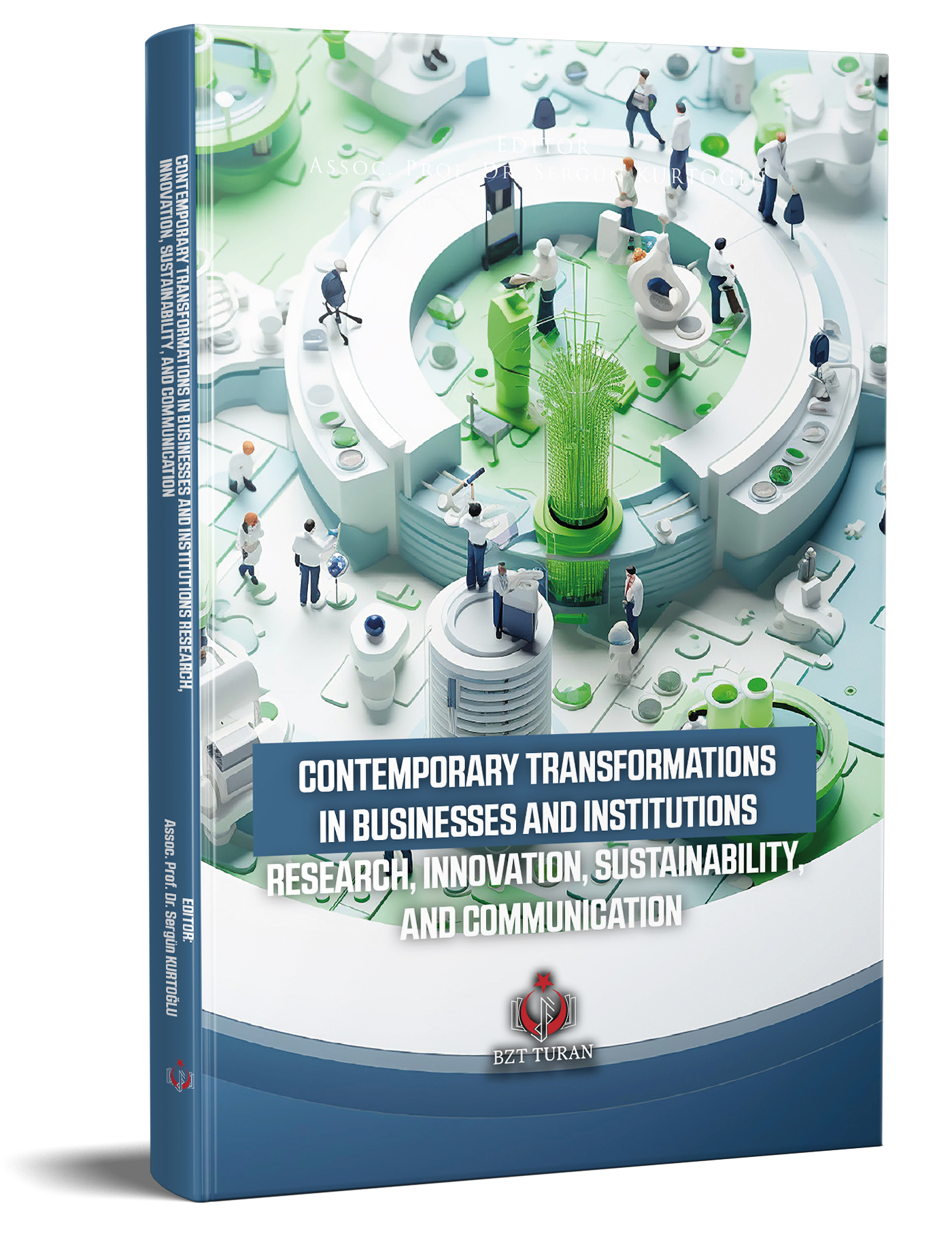
Contemporary businesses and institutions are being reshaped not only by economic and managerial transformations, but also by digitalization, sustainability, communication dynamics, employee well-being, and evolving modes of knowledge production. Although these developments may appear across different domains of institutional life, they are deeply interconnected, influencing decision-making processes, organizational structures, stakeholder relationships, and broader conceptions of institutional responsibility. As such, contemporary institutions can no longer be understood through a single variable or within the सीमित boundaries of a single discipline.
This volume brings together five studies that examine these processes of transformation from distinct yet complementary perspectives. Its primary aim is to offer a more comprehensive understanding of contemporary institutions—one that extends beyond narrowly defined managerial concerns or purely technical developments. Instead, it emphasizes the interconnected dimensions of knowledge production, strategic orientation, human-centered approaches, institutional sustainability, and communication. In this sense, the book is not merely a collection of individual studies; it proposes a shared intellectual framework for interpreting the layered and multidimensional nature of institutional transformation.
Today, the effectiveness and influence of institutions are evaluated not only by what they produce, but also by how they respond to change, how meaningfully they leverage digital opportunities, how they balance employee expectations with well-being, how deeply they integrate sustainability into their structures, and how effectively they communicate with diverse publics. While the chapters in this volume address different themes, they collectively form a coherent whole, highlighting the core components of contemporary institutional capacity. The distinctive contribution of this book lies in its ability to bring together discussions that are often treated separately and to interpret them through a unified perspective of institutional transformation.
The opening chapter, by Nasrullah Jan and Almabrok F. Ahmid, “Bibliometric Analysis of the Borsa Istanbul Review Journal: Eleven Years Review,” examines the development of the Borsa Istanbul Review between 2013 and 2024 through a bibliometric approach. By analyzing publication trends, citation patterns, thematic concentrations, and international collaborations, the chapter not only evaluates a journal but also illustrates how academic knowledge in the field of finance has evolved over time. As the first chapter, it provides a meaningful point of departure, emphasizing the importance of situating institutional and managerial transformation within broader academic contexts.
The second chapter, Aylin Yılmaz Gezgin’s “The Importance of Digital Innovation in Strategic Management,” highlights the growing strategic significance of digital innovation in organizational contexts. It demonstrates that digital innovation is no longer limited to technological advancement, but has become a strategic imperative for achieving competitive advantage, developing new business models, accelerating decision-making processes, and ensuring long-term sustainability. Notably, the chapter links digital innovation to data-driven decision-making, organizational transformation, customer value creation, and strategic flexibility.
The third chapter, Derya Torun’s “Theoretical Construction of Digital Well-Being in the Age of Addiction,” examines digital addiction and problematic technology use from the perspective of organizational culture. Moving beyond an individual-centered explanation, the study explores the roles of constant availability, evolving work patterns, leadership practices, and regulatory frameworks. It highlights that digital well-being is not solely an व्यक्तिगत concern but also an institutional responsibility, shaped significantly by implicit organizational norms.
The fourth chapter, also by Derya Torun, “The Theoretical Foundations of Corporate Sustainability in Higher Education Institutions,” focuses on sustainability within universities. It analyzes institutional sustainability through the dimensions of governance and organizational structure, infrastructure, evaluation and reporting, and education and research. The chapter argues that universities must approach sustainability through integrated institutional strategies rather than fragmented initiatives, positioning them not only as centers of knowledge production but also as institutions with environmental, social, and managerial responsibilities.
The fifth and final chapter, “Effective Communication in Businesses and Institutions: Target Publics, Planning, and Communication Barriers,” conceptualizes communication as a complex and multilayered institutional process. Rather than viewing communication as a linear transmission of information, it emphasizes meaning-making, feedback mechanisms, audience diversity, cultural context, and strategic planning. By addressing the limitations of treating target publics as homogeneous and analyzing communication barriers, the chapter underscores the central role of communication in achieving institutional effectiveness and sustaining relationships.
Taken together, the chapters in this volume demonstrate that contemporary business and institutional life cannot be adequately explained through narrow or one-dimensional frameworks. Strategic management, digital transformation, employee well-being, sustainability, communication planning, and academic knowledge production are deeply interconnected dimensions of a broader process of institutional change. One of the key strengths of this book lies in its ability to bring these themes into dialogue and present them as interrelated dynamics rather than isolated topics.
It is my hope that this volume will serve not only as an academic contribution but also as a practical framework for researchers, practitioners, managers, and decision-makers. More broadly, it aims to contribute to ongoing discussions on how institutions can become more effective, adaptive, responsive, and sustainable in an increasingly complex world.
May this volume inspire further research, encourage interdisciplinary thinking, and offer valuable insights to readers seeking to understand the evolving realities of contemporary institutional life.
Assoc. Prof. Dr. Sergün Kurtoğlu


Reviews
There are no reviews yet.