


PREFACE
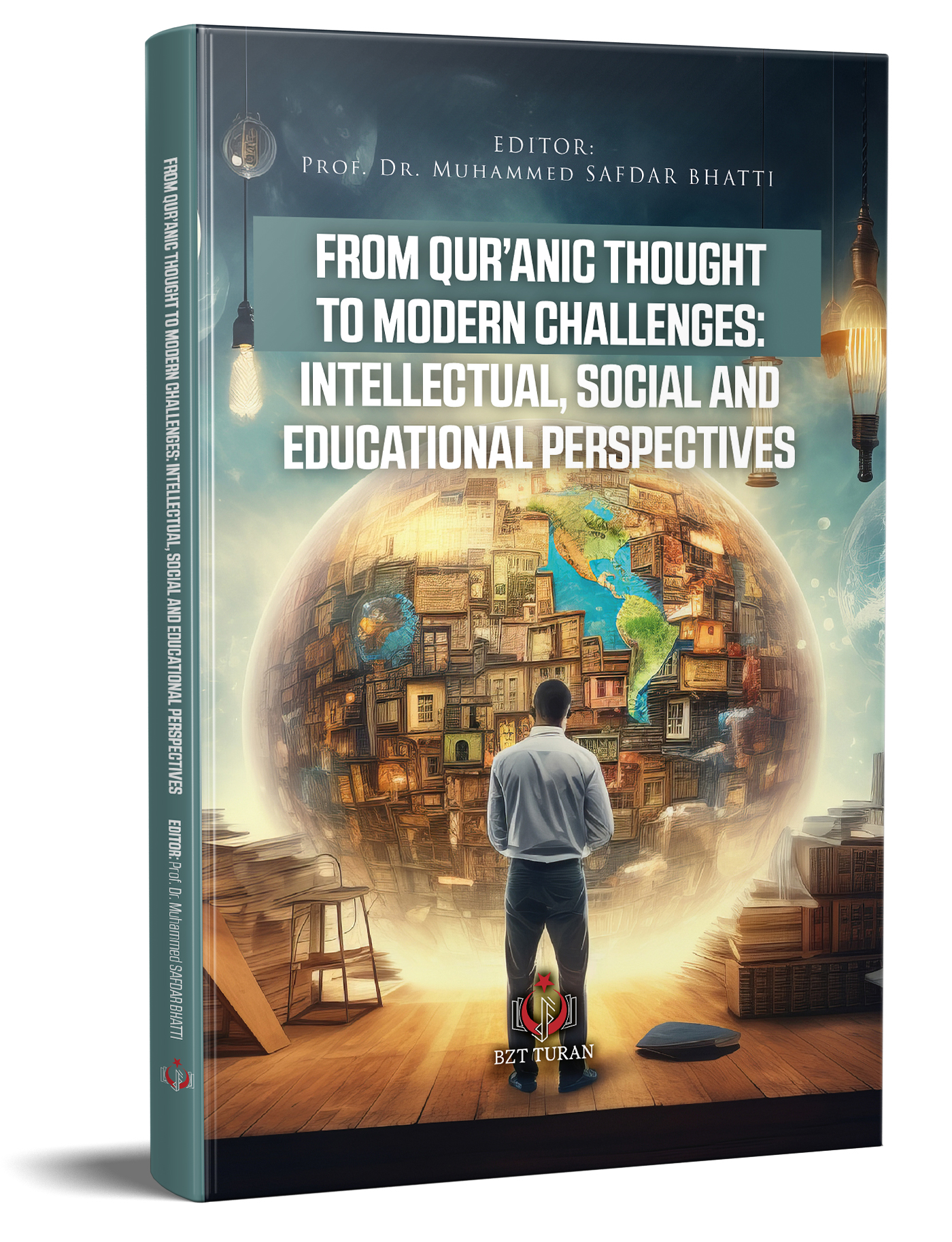
In the contemporary academic world, where interdisciplinary approaches have gained increasing significance, it becomes ever more essential to revisit the intellectual and cultural foundations of humanity. The studies presented in this volume represent a diverse yet interconnected attempt to address the multifaceted dimensions of religion, society, education, and history from both classical and contemporary perspectives.
The first contributions examine the Qur’ān as a guide for human intellect and reflection, highlighting concepts such as contemplation (tedebbür), iʿtibār, taakkul, tadhakkur, and ruʾyah. Through these, the Qur’ān not only directs human beings to recognize the existence and unity of God but also emphasizes the responsibility of employing reason in understanding the relationship between God, humanity, and the universe. Thinking, in this regard, is presented as a fundamental act of worship and a pathway to truth.
Another important focus is on Imam Abū Manṣūr al-Māturīdī, whose scholarly identity and intellectual legacy stand at the heart of the Ahl al-Sunnah tradition. His epistemological insights, as well as his contributions in kalām, fiqh, and tafsīr, are revisited here in relation to the political, cultural, and academic environment of his time. By situating Māturīdī within the vibrant intellectual milieu of Bukhara, Nishapur, and Samarkand, this study sheds light on how he shaped a rational and tolerant discourse that continues to inspire theological thought today.
The metaphor of fermentation is then employed to explore the dynamics of social thought. Just as fermentation in the biological sense signifies transformation and maturation, the metaphor here encapsulates the evolving processes of religious, cultural, and intellectual development across history. From the Abbasid period to Al-Andalus and the Ottoman experience with the printing press, and further into the digital age, the analysis demonstrates how values, norms, and beliefs are continuously reshaped through individual reflection and collective interaction.
The volume also addresses contemporary socio-political issues, such as the Palestine question through the eyes of preschool children, offering a poignant reminder that political realities inevitably permeate educational contexts and early stages of identity formation. This dimension highlights the role of pedagogy not only as a means of instruction but also as a field deeply affected by global conflicts and struggles for justice.
Finally, a historical exploration of the Bakr b. Wāʾil tribe during the caliphate of ʿUmar b. al-Khaṭṭāb underscores the significance of tribal networks in administration, military strategy, judiciary practices, and diplomacy. By analyzing their roles within the broader policies of governance, the study provides valuable insights into how pragmatic leadership and merit-based appointments facilitated the consolidation of the early Islamic state.
Taken together, these studies illuminate the interplay of reason and revelation, tradition and transformation, individual consciousness and collective identity, local contexts and universal values. They remind us that intellectual inquiry is never confined to a single domain but rather flourishes at the intersections of theology, history, sociology, education, and politics.
It is our hope that this collection will serve as an inspiration for scholars and students alike, encouraging deeper engagement with the enduring questions of faith, reason, society, and human destiny. By bringing together perspectives from the Qur’ān, Islamic intellectual history, social theory, pedagogy, and early Islamic governance, the volume aspires to contribute to the ongoing dialogue between past legacies and present challenges in an ever-changing world.



Değerlendirmeler
Henüz değerlendirme yapılmadı.